
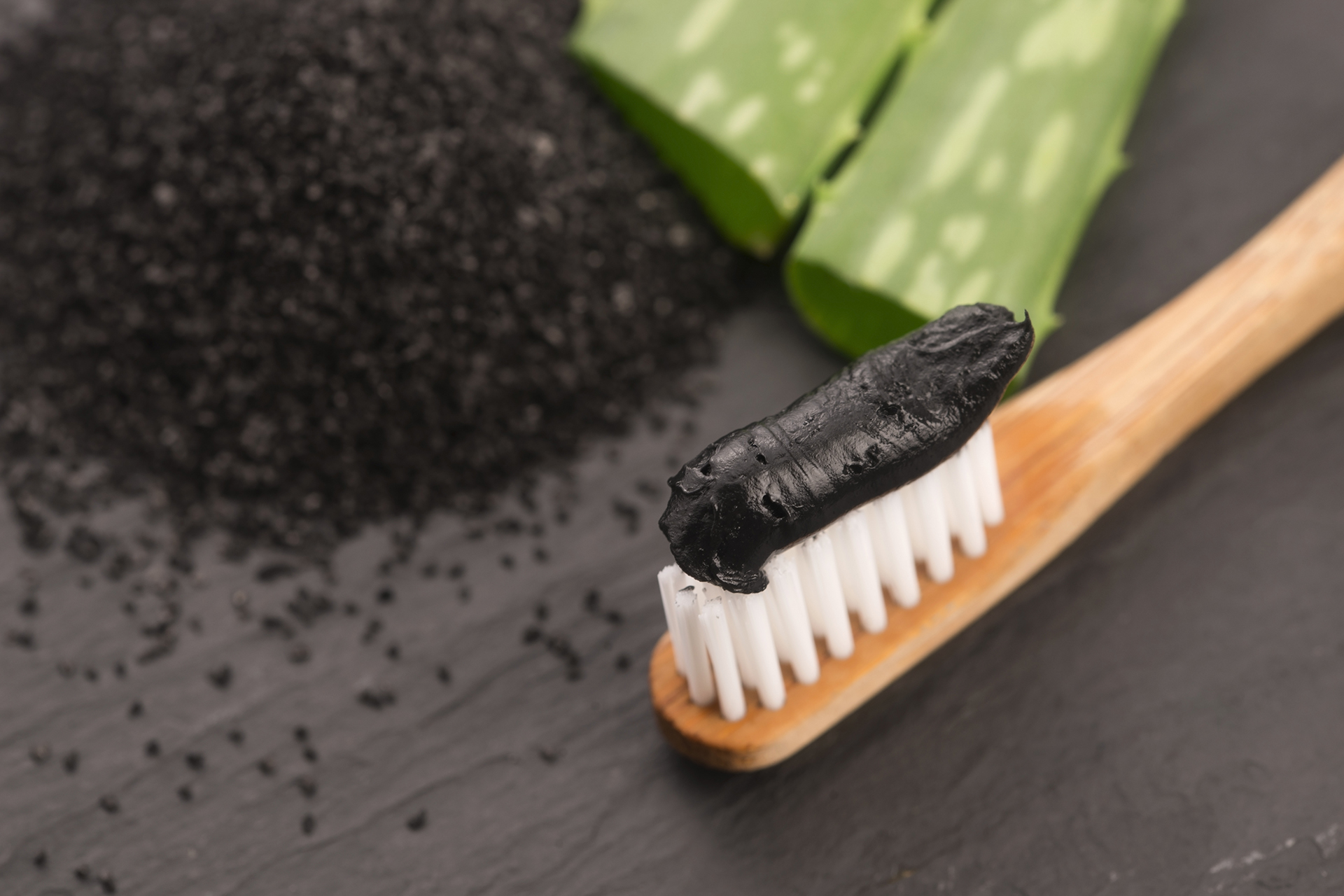
Gardner, an IT specialist who lives in Bowling Green, Kentucky, bought some after seeing Facebook ads for charcoal toothpaste and watching YouTubers spread the jet-black goop or powder on their teeth, brush it until their mouth looks thoroughly infested by an onyx slime, and rinse to reveal a brighter, somehow-whiter smile.
“I kind of looked at it and thought, ‘It can’t hurt to try it,” Gardner said. “I was more excited to see my mouth turn black than anything — that was the reaction I was looking for.”
Gardner said he imagined it might be abrasive for people with sensitive teeth, but to him, it works and feels like any other toothpaste — except that is seems to do a better job of whitening.
Charcoal toothpastes and powders promise to whiten and clean teeth naturally — but dentists and researchers worry there’s not enough testing of the products’ safety, and that they could do more harm than good to users’ oral health. Limited studies even suggest the charcoal’s size and composition could actually roughen tooth enamel, which protects teeth from decay and cannot regenerate.
“In dentistry, everything we do should be evidence-based and there’s just not enough evidence to support any of these claims, really,” said Brooklyn dentist Igor Khabensky. “At this point in time, it’s a ‘buyer beware’ outlook.”
The charcoal trend is one of many “natural” products and health solutions that are popular regardless of whether they’re backed by science, said Tyrone Rodriguez, a dentist at Yale New Haven Hospital. “People are looking for alternatives, and dentistry hasn’t been an exception.”
Some people have begun mashing strawberries with baking soda to make homemade toothpaste or self-treating dental conditions with spices like turmeric. Others have “re-discovered” oil pulling, the practice of swishing a tablespoon of oil around in the mouth for 20 minutes
And then there’s charcoal toothpaste (to be clear: not the same charcoal as what you’d throw on the grill).
Activated charcoal is made by burning certain materials — coconut shells, bones, sugar, coal, peat, wood or petroleum — then ‘activating’ the charcoal by heating it in 1,100- to 1,600-degree-Fahrenheit steam, air or carbon dioxide. The product is then washed and dried to create an incredibly porous and fine-grained product, according to the World Health Organization.
Activated charcoal does have its evidence-backed medicinal uses (in 2017, the WHO included activated charcoal on its list of essential medicines that compiles the most effective, safe and economical medicines for priority conditions). Doctors use activated charcoal in emergencies to treat specific kinds of poisoning to help prevent the stomach from absorbing poison into the body, the Mayo Clinic says. However, the Clinic warns, it should be taken only under the advice of a poison control center, doctor or emergency room staff.
In fact, powdered charcoal, soot or coal ash has been used for hundreds of years — to clean teeth using fingers, cloth or chewing sticks — in countries including Bangladesh, the United Kingdom, Nigeria, Italy and Malaysia.
The first records of…
